
Why does a simple “sign in” feel like a risk-management decision on an exchange that offers futures, staking, and a Web3 wallet? Framing the OKX login as a gateway—technically simple but operationally consequential—helps clarify trade-offs that many traders overlook. The mechanics of account access shape custody choices, liquidity access, and your exposure to phishing, KYC friction, and platform-level controls. For US-based traders deciding whether to use OKX for spot trading, the sign-in flow is the first place where technology, regulation, and personal security intersect.
This short commentary peels back the layers: the authentication model, how it connects to spot and margin trading, where it limits you, and what to watch next. You’ll come away with a sharper mental model for deciding when to trade on a centralized exchange (CEX) like OKX versus keeping assets in a self-custodial wallet or moving to a decentralized route.
How OKX sign-in works — the mechanism, step by step
At its core the OKX login is multi-layered. First, identity verification (KYC) links your legal identity to your account: a government ID upload and a facial liveness check are required to pass compliance gates. Second, the account authentication stack enforces two-factor authentication (2FA) — options include SMS, an authenticator app, and biometric options on mobile devices. Third, the exchange adds behavioral and AI-driven monitoring that flags unusual login patterns in real time and can require extra verification or temporary holds.
Mechanism matters because each layer changes what happens after you sign in. KYC ties transactions to a legal identity and enables fiat on-ramps and regulatory compliance, but it also creates a permanent connection between your trading history and your person. 2FA and device biometrics reduce account-takeover risk, yet SMS-based 2FA remains vulnerable to SIM-swapping—so the choice of method affects practical risk. Finally, the AI-driven threat detection can freeze withdrawals after anomalous logins; that protects assets from external attackers but can delay legitimate access when you need to move quickly in volatile spot markets.
Spot trading on OKX: access, limitations, and the role of login
Spot trading is straightforward conceptually: buy and sell at market prices. But access is gated by account status. A fully verified OKX account unlocks spot markets, margin borrowing up to 10x, and token transfers to the Web3 wallet. If you haven’t completed KYC, you may face limits on deposits, withdrawals, and trade sizes; that will influence your ability to execute a large rebalance or seize an arbitrage window.
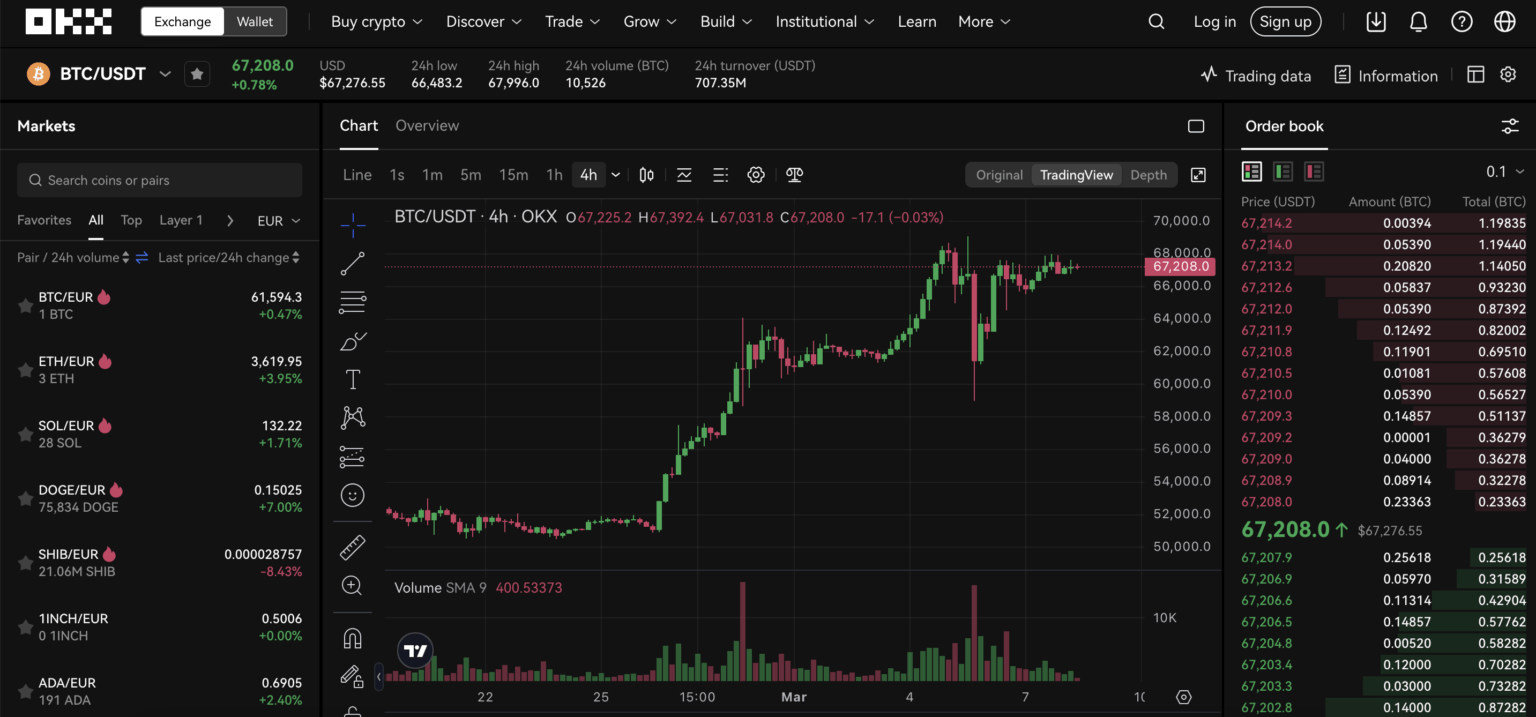
Operationally, the sign-in session is the instrument for order submission. Web sessions route through the TradingView interface on OKX’s web app, while mobile sessions benefit from biometrics and sometimes faster confirmations. Traders should be aware: during high volatility, slippage and liquidity gaps on low-volume pairs can mean the difference between executing at a target price and suffering a materially worse fill. A quick login is necessary but not sufficient — you need pre-funded accounts and an accepted 2FA method that you can access reliably under stress.
Custody choices exposed by logging in
One non-obvious trade-off is the custody continuum. OKX operates both a centralized exchange custody model and a non-custodial Web3 wallet you can pair with the platform. Signing into your OKX CEX account grants access to the custodial order book and spot liquidity, while the Web3 wallet keeps private keys in your control. That dual architecture is powerful but confusing: being logged into the exchange does not automatically mean your assets are self-custodial, and conversely, controlling a wallet does not give you direct access to exchange order books without on-chain transfers.
Why this matters: centralized custody provides faster market access and often better liquidity for large spot trades, but it places withdrawals and access control under the exchange’s operational procedures (cold storage withdrawals require multi-signature approvals). Self-custody reduces custodial counterparty risk but introduces the risk of lost seed phrases and slower execution if you must bridge tokens to a CEX to trade. Your login choice—where and how you authenticate—determines which side of this trade-off you inhabit in real time.
Security, delistings, and real-world operational impacts
Security measures are robust: OKX claims over 95% of custodial assets in offline cold wallets with multi-signature controls, and Proof of Reserves gives users a way to verify 1:1 backing. Still, the act of signing in is the most common vector for social-engineering attacks and credential theft. Phishing pages that mimic the OKX login prompt are an active risk, especially when paired with messages about account holds or delisting notices that push users to login immediately.
Delistings — like the recent removal of several spot pairs this week for tokens such as RSS3 and others — emphasise another operational reality: not all assets remain tradable indefinitely. If you hold a token that gets delisted, timely access to your account matters because delistings can trigger transfer windows, reduced liquidity, or forced conversions in extreme cases. That’s why understanding both the exchange’s security posture and its market maintenance policies matters before you rely on a single CEX for custody.
Practical heuristics: a simple decision framework for US spot traders
Here’s a compact, reusable framework to decide how to use OKX for spot trading given the sign-in mechanics and platform features:
– If you need fast access to deep liquidity and fiat rails (e.g., large BTC/ETH spot trades), use a verified OKX account with hardware-backed 2FA and keep funds in the exchange but under strict withdrawal whitelists. Remember: faster access trades off with counterparty custody risk.
– If you prioritize control and are trading small or experimental tokens, use the OKX Web3 non-custodial wallet and connect to DEX aggregators for swaps; accept slower execution and bridging costs in exchange for private key control.
– For margin trades or leveraged spot exposure, treat login reliability as part of your position sizing: make sure session and 2FA methods work from your primary trading device and maintain contingency withdrawal options in case of account freezes.
What to watch next — signals that should change your behavior
Monitor three things: policy changes around KYC (these affect account friction and limits), Proof of Reserves updates (these affect confidence in custodial backing), and delisting announcements (affect asset availability and migration timing). Also watch the evolution of 2FA norms: if exchanges move away from SMS and toward hardware-based or biometric-first 2FA, adapt earlier rather than later. Any systematic increase in forced withdrawal holds or frozen accounts is a red flag that should prompt you to reduce custodial exposure.
If market structure changes — for example, widening spreads on low-volume pairs after delistings — that will alter the cost-benefit calculation for using CEX liquidity versus DEX routes.
FAQ
Do I need to complete KYC to use OKX for spot trading in the US?
Yes. KYC is required to unlock full functionality, including fiat deposits, large withdrawals, and most spot trading features. Partial access may be granted for browsing and limited deposits, but expect strict limits unless KYC is complete.
Which 2FA method should I use when signing in?
Prefer an authenticator app or hardware-backed biometric on mobile over SMS. Authenticator apps reduce SIM-swap risk; hardware keys or biometric-protected devices add stronger protection, especially for larger balances or active traders.
Can I trade on OKX without giving up custody of my private keys?
You can use the non-custodial OKX Web3 wallet to keep private keys, but that wallet is separate from the centralized exchange order book. To access exchange liquidity you typically need to transfer assets to the custodial account, which is a custody trade-off.
What should I do if a token I hold is delisted?
Act quickly but calmly: check the exchange notice for withdrawal windows and migrate assets to another supported network or a self-custodial wallet if necessary. Expect liquidity to thin before and after delisting, which can increase slippage and transfer costs.
Signing in is technical, but its consequences are strategic. For US spot traders, the login flow determines not only your security posture but also what markets, leverage levels, and liquidity you can realistically access. Treat login choices as part of your trading toolkit: choose authentication and custody models matched to the size and speed needs of your strategy, and monitor policy and market signals that could force rapid changes in access.
If you want a quick, official pointer to the exchange’s web login and guidance for session setup, start here: okx sign in.
